

This is for: Finance directors, controllers, and accounting heads at medium and large businesses who need to know if the BIR e-invoicing mandate covers them, whether their current system qualifies, and what to fix before December 31, 2026.
It is a management meeting, and the CFO asks the accounting head a plain question. Are we ready for the BIR e-invoicing deadline?
The answer sounds solid.
We issue invoices straight from the accounting system. We email PDFs. Clients who want a printed copy get one. Every line of that is true. But none of these means the company is ready.
Revenue Regulations No. 11-2025 is specific about an invoice a system produces and then prints. If the business cannot electronically report the sales and invoice data, that invoice does not count as electronic. The regulation calls it a traditional, manually issued invoice. So a company can run modern software, issue thousands of invoices a year, and still sit at zero.
Readiness is not about having software. It is about producing structured invoice data the BIR can extract and receive. This article checks that in five parts, then points to what to fix first.
Key takeaways:
- The deadline is December 31, 2026. RR No. 26-2025 moved it from an earlier March 2026 date.
- Using accounting or invoicing software is itself a trigger. It is the fourth covered group in RR No. 11-2025, and the widest one.
- A printed invoice from your system does not count. Neither does a PDF. The regulation requires structured invoice data.
- One covered branch pulls in the head office and every other branch.
- Medium and large taxpayers deduct 50% of their setup cost. Micro and small deduct 100%.
Start by assuming you are covered
Most medium and large businesses waste time here, asking whether the mandate applies before checking whether their system can meet it.
For this audience, the answer is almost always yes, and for one reason.
If you run a Computerized Accounting System or any invoicing software, RR No. 11-2025 covers you.
That is the fourth and widest trigger, and it needs no online sales and no ₱1 billion threshold to catch you.
If you want the full list of triggers and how coverage is attached by entity type, subsidiary, branch, exporter, RBE, POS, our guide on e-invoicing in the Philippines walks through it.
One thing worth carrying over: the branch rule.
One covered registration pulls in the head office and every branch, so a readiness check has to run across all of them, not just the one that tripped first.
So skip the debate about whether you are in.
Assume you are, and move to the question that actually decides your December 31, 2026. Can your system produce and transmit what the BIR asks for?
What do I need to have ready before the deadline?
Five things, and only one of them is software.
Structured invoice data. Not a document. A machine-readable file in the BIR’s format, which is JSON, carrying the seller and buyer details, line items, tax treatment, and totals as data fields the system can read, not as text on a printout.
A way to sign and transmit it. Your system signs each invoice with a JSON Web Signature and sends it to the EIS by API. A PDF sitting in an inbox does not meet this.
A Permit to Transmit. You apply to the BIR, pass its system testing, and receive the permit before you can transmit live. This is a process with lead time, not a download.
Scope across every registration. The branch rule pulls the whole structure in, so count your TINs first.
Time to test. Certification and testing sit between a ready system and your first live transmission. That gap is the part companies underestimate.
Is my current accounting or POS system enough?
Probably not on its own. RR No. 11-2025 requires the system to generate structured invoice data that it can extract and transmit to the BIR, a much higher bar than printing an invoice.
A printed invoice, a PDF, or a system that was BIR-registered under the old rules all fall short. None of them transmit structured data to the EIS.
So the real question is narrow. Can this system output the BIR’s format, sign it, and transmit it to the EIS?
If the answer is a maybe, treat it as a no until someone tests it.
Readiness at a glance
| What you have | Ready? | What is missing |
| Manual or pre-printed invoices | No | Everything. Structured data, transmission, permit |
| Accounting software, invoices printed | No | The system generates a document, not transmissible structured data |
| Accounting software emailing PDFs | No | A PDF is not structured invoice data |
| POS system, no reporting capability | No | Counts as manual invoicing under RR No. 11-2025 |
| ERP with a certified EIS connection, no Permit to Transmit | Almost | The permit, plus BIR testing |
| Structured JSON, signed, transmitting, permit in hand | Yes | Keep it working and keep the records |
One caution on vendors. The BIR does not accredit EIS software providers during the pilot phase, so any vendor calling itself BIR-accredited today is claiming a status that does not exist yet. EIS-ready and BIR-accredited are not the same thing.
What should I fix first?
Start with facts about your business, not a purchase.
- Count your registrations. Head office, every branch, every TIN. Groups that grew by acquisition usually find more than the org chart shows.
- Test each one against the five checks. Note which trigger applies to which registration. One yes covers the structure.
- Ask your system owner one question. Can this produce the BIR’s structured invoice format and transmit it today, without a new module? Get the answer in writing.
- Map the gap, then buy. Once you know how many registrations must transmit and what your system cannot do, you buy against a real specification, not a sales pitch.
- Start the Permit to Transmit process early. The taxpayer applies, not the vendor. Certification, testing, and the permit all sit ahead of your first live invoice.
- Budget it as partially recoverable. Medium and large taxpayers deduct 50% of the setup cost from taxable income, micro and small 100%, claimed once in the year you complete the system or make final payment. An imported system is also exempt from tax on the importation.
Notice what is not on this list. Choosing a vendor is step four, not step one.
Where Taxumo fits
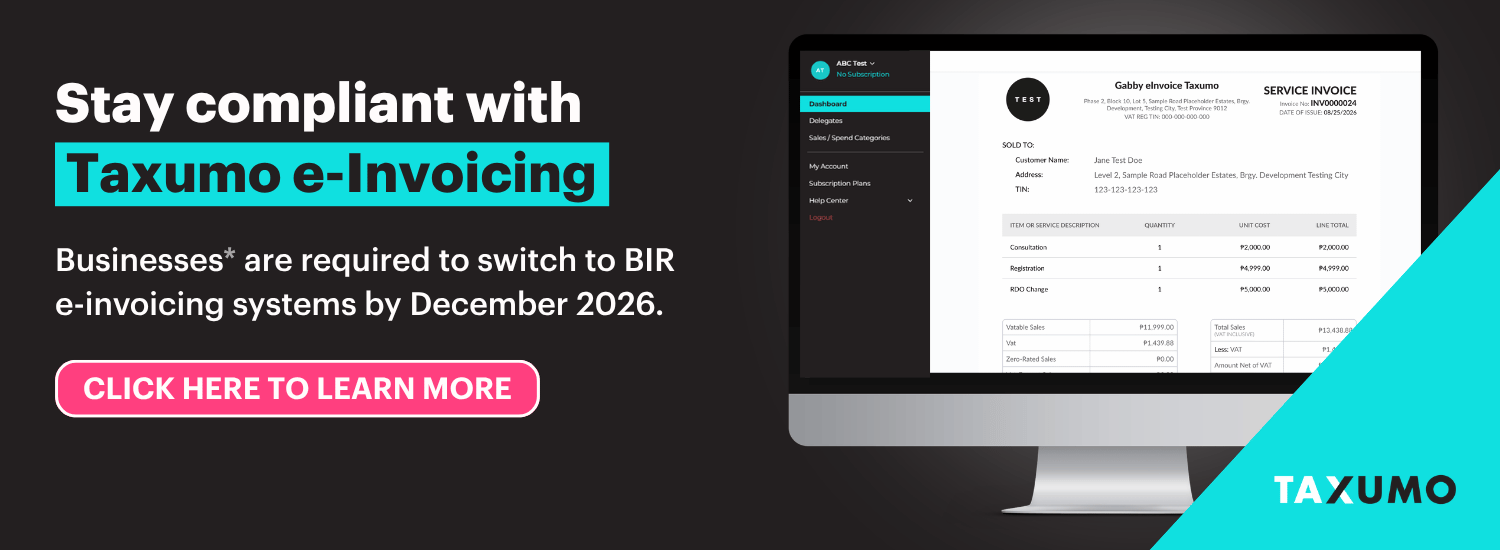
Taxumo’s EIS-ready eInvoice connects to your existing accounting system through APIs. So your entity produces structured invoices in the BIR’s format and your filing and invoicing stay linked in one place.
For a business running several registrations, that means one system that speaks to the EIS across the whole structure, rather than a separate fix per branch.
To see the output first, here is how to generate an EIS-ready eInvoice for your business.
What happens if I am not ready by December 31, 2026?
Section 264-A of the Tax Code sets the penalty for failing to transmit sales data, and it runs per day.
The daily amount is one-tenth of one percent of annual net income from the audited financial statements of the second year preceding the current taxable year, or ₱10,000, whichever is higher.
Pass 180 days of violation in a taxable year and the BIR can permanently close the business.
So the floor is ₱10,000 a day, scaling with net income, on a clock that does not stop until you comply.
For a taxpayer with several registrations, a quiet delay is not a quiet cost.
Quick answers to what finance teams keep asking
Using software but not selling online? Still covered. The software itself is the trigger, with no online sales requirement attached.
Vendor says you are already EIS-ready? Get it in writing that the system outputs the BIR’s structured data, transmits to the EIS by API, and can hold a Permit to Transmit, then test it end to end. No vendor can claim BIR accreditation yet, since the BIR does not accredit providers during the pilot.
Have to replace your ERP? Usually not. Most setups keep the ERP as the data source and add a layer that formats and transmits to the BIR, through an API.
How fast must data reach the BIR? Guidance points to three calendar days from the transaction. Confirm the exact timing for your registration, since the BIR is still issuing the sales reporting rules.
Could the deadline move again? RR No. 26-2025 lets the Commissioner extend it, and it already moved once from March 2026. Plan against December 31, 2026 anyway, because testing takes the same time either way.
Do micro taxpayers have to comply? No. They are exempt and may keep issuing a registered manual invoice, though they can opt in.
The bottom line on BIR e-invoicing readiness
The gap most medium and large businesses find is the same one. They have invoicing software, which puts them in scope, and that same software cannot produce what the mandate asks for.
None of the work to prove that requires a vendor to tell you.
December 31, 2026 covers several moving parts: system output, certification and testing, the Permit to Transmit, and a first live transaction that has to work.
Finding the gap in August gives you room. Finding it in November does not.
To see what an EIS-ready invoice looks like from a Philippine-side system, take a look at Taxumo eInvoice and walk through your registrations with us.


This article is based on Revenue Regulations No. 11-2025, RR No. 26-2025, RR No. 8-2024, RR No. 8-2022, RR No. 13-2021, and Sections 106, 108, 237, 237-A, 264-A, and 304(D) of the Tax Code, as amended by RA No. 12066 (CREATE MORE Act). It is for general information only. For advice specific to your business, please consult a CPA or tax professional.