
If you’re covered by the BIR’s e-invoicing rules, you have one practical question: what do you actually need to do to create an invoice that qualifies?
This article walks through that. What an EIS-ready BIR format invoice has to look like, how Taxumo helps you create one, and how it connects to your tax filing so you’re not running two separate systems.
What makes an eInvoice “EIS-ready”?
Before anything else, let’s clear up a common misunderstanding.
An EIS-ready invoice is not just a digital version of your paper invoice. It’s not a PDF you emailed to a client, and it’s not a scan or photo of a receipt.
Under Revenue Regulations No. 11-2025, the BIR is specific about the format, and a good-looking document is not enough.
To be EIS-ready, an invoice has to meet these conditions.
- It has to be created by BIR-accredited software.
You can’t make one in Word, Excel, or Google Docs, and you can’t design one in Canva.
The system that generates the invoice has to be accredited by the BIR, because that software is what builds the invoice in the right shape and adds the technical pieces the BIR requires.
💡 Worth noting: as of today, the BIR does not accredit EIS software providers at all. The system is still in its pilot phase, so there is no accreditation process and no official list of accredited EIS providers yet. If a provider claims to be “BIR-accredited for EIS,” be cautious, because that accreditation does not exist.
- It has to be in a format the BIR can read on its own. This is the part most people miss.
The phrase to hold on to is structured data
Your invoice needs to carry specific information that lines up with what the BIR expects: who sold (seller details), who bought (buyer details), what was sold, how much, and what taxes apply.
When all of that is captured in the right structure and is ready to be transmitted on time, the invoice is EIS-ready. - It has to be ready to be sent to the BIR on time.
The data has to reach the BIR’s EIS platform within three calendar days of the transaction. Miss that window and the invoice is not compliant.
In the Philippines, invoicing is a compliance issue, not just a format issue
This is the change that matters most.
Under the EIS, every covered invoice is also a report to the BIR. The moment you issue one, the BIR expects the data within three days, in its format, from accredited software.
Your invoice is now a direct line to the tax authority, not only a document between you and your client.
Here’s why that turns invoicing into a compliance question rather than a design one.
The rules come from the BIR, and they move. RR No. 11-2025 set the mandate, then RR No. 26-2025 pushed the deadline to December 31, 2026. More issuances and circulars will follow as the system rolls out.
Staying compliant means staying updated, and the gap between a new BIR issuance and your system catching up is exactly where a business gets caught. You want a software provider that has worked with the BIR for years.
The BIR is now on the other end of every transaction. When you transmit an invoice, the BIR’s system checks it and can accept or reject it, and the three-day window applies to each covered transaction.
💡 There are real penalties. The BIR can impose penalties under the Tax Code (Sections 264 and 264-A) when a business does not comply. Because the obligation attaches to each covered invoice.
And it’s continuous. This is not a setup you finish once. Every covered sale, every day, has to be issued, structured, and transmitted correctly. If you run more than one location, each branch carries the same obligation.
And when the tax rules change, the technical build often has to change with them. A new issuance can mean new fields, a new format, or a new way of transmitting, and your system has to be updated before your next invoice goes out.
So the question is no longer whether your invoice looks right. It’s whether each invoice is issued, structured, and transmitted the way the law requires, every time and it should conform to the current BIR taxation rules at any given time.
Keeping up with the BIR is not only a compliance job, and it’s not only a technical one.
When a new issuance drops, someone has to understand what it actually requires, then turn that into a working change in the system, and do it before your next transaction.
You need a team that has both the compliance knowledge and the technical capability to act on it quickly.
Why Taxumo can help you generate an EIS-ready BIR format invoice
Taxumo is a BIR-accredited tax service provider (TSP) and has helped Filipinos file taxes automatically and online for years.
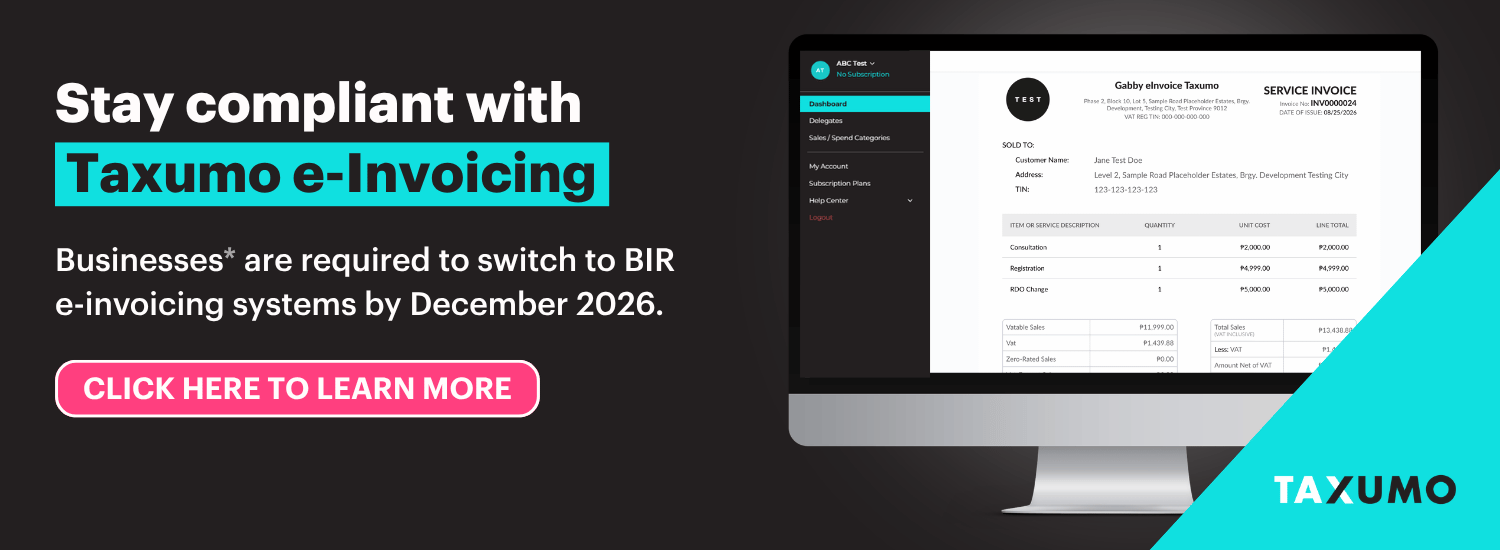
For e-invoicing, Taxumo has an EIS-ready eInvoicing system, built to meet the BIR’s technical requirements for format and data structure.
Invoicing and tax filing are separate processes under the law, but they’re linked: a change in one will sometimes require a change in the other. From years of working with the BIR as a tax service provider, we’ve learned how to design our e-invoicing system the way the BIR expects and how to time each system change to a new issuance, so the same data flows cleanly from one to the other.
Can you connect Taxumo to your existing accounting system?
Yes. Taxumo has APIs, so it can connect to the accounting software your business already uses.
The invoice data you generate in Taxumo can be shared with your accounting system as needed.
This helps you avoid double entry. For businesses that issue a high volume of invoices, the API enables automatic transmission to the BIR’s EIS instead of uploading files one by one.
Who needs to issue EIS-ready invoices, and how Taxumo can help
Taxumo is EIS-ready for every group the mandate covers. That includes the e-commerce sellers, large taxpayers, and software users who have to go live by December 31, 2026, and the groups that follow once the BIR issues their own rules.
Here’s who is covered and how each can work with us.
Required by December 31, 2026
These groups must issue structured e-invoices by December 31, 2026, under RR No. 11-2025 and RR No. 26-2025.
- Businesses in e-commerce or internet transactions, classified as Small, Medium, or Large taxpayers. Micro taxpayers are exempt.
With Taxumo’s EIS-ready e-invoicing platform, you don’t need a tech team for this. We built a standardized platform that scales for e-commerce and web-based businesses. We’re fintech, so we understand how you operate. - Taxpayers under the BIR’s Large Taxpayers Service (LTS).
- Large Taxpayers under the Ease of Paying Taxes Act (RA No. 11976) and RR No. 8-2024.
- Taxpayers using a Computerized Accounting System (CAS), Computerized Books of Accounts (CBA) with electronic invoicing, or other invoicing software.
For groups 2, 3, and 4: Taxumo has ready APIs you can plug into, and we can integrate with your existing accounting system. Book a call and we’ll walk through your setup. If you’re a CAS provider, we’re ready to work with you too. Email einvoicing@taxumo.com.
Required later, once the BIR issues separate rules
Once the BIR sets up a system to store and process the data, the following groups will be required to issue e-invoices, under separate Revenue Regulations:
- Exporters of goods and services under Sections 106 and 108 of the Tax Code, except those under Section 3(A)(4) of RR No. 11-2025.
- Registered Business Enterprises with tax incentives under Section 304(D) of the Tax Code, except those under Section 3(A)(4) of RR No. 11-2025.
- Taxpayers using a POS system.
- Other taxpayers the Commissioner may require.
We’re ready to serve you, too. We can start the conversation now so you’re prepared the moment the rules for your group take effect.
We’ll handle the system adjustments and coordinate with the BIR on your behalf. Because this is a compliance concern with a technical build behind it, you want both in one team, and that’s what we bring.
If your business falls into any of these groups, now is a good time to check whether your current setup meets the requirements or whether you need to make changes before the deadline.
💡 This article is based on Revenue Regulations No. 7-2024, No. 11-2025, and No. 26-2025. It is for general information only. For advice specific to your business, please consult a CPA or tax professional.


Pingback: Philippine E-Invoicing for Foreign Companies: 2026 Deadline