
If you’ve been hearing a lot about “e-invoicing” lately and wondering whether it actually affects you, the short answer is: it probably does, especially if your business uses any kind of accounting software, sells online, or has been classified as a Large Taxpayer.
BIR has set a deadline of December 31, 2026 for the first group of businesses to start issuing what they call an EIS ready BIR format invoice. So let’s go through how this EIS ready invoice is going to unfold for businesses.
Still asking “am i required to get digital invoices?” Take the quiz below.
Why is the BIR requiring an EIS ready invoice?
BIR wants to modernize how businesses report their sales. Right now, most businesses record their transactions either manually by receipts or through CAS and then summarize everything when it’s time to file taxes — quarterly or annually. However BIR wants to make these transactions easy by receiving it in real time
Think of it like this: instead of submitting a summary at the end of the quarter, your invoicing system would send the data to the BIR automatically as you issue each invoice.
This is what the EIS (Electronic Invoicing/Receipting System) is for.The BIR uses this system to receive and store invoice data from businesses.
The legal foundation for this are two regulations:
Revenue Regulations No. 11-2025 — issued February 27, 2025. This is the main regulation that explains who needs to comply, what an EIS ready invoice looks like, and when everything needs to be in place.
Revenue Regulations No. 26-2025 — issued September 5, 2025. This one extended the compliance deadline from March 2026 to December 31, 2026, because the BIR recognized that businesses needed more time to transition.
The CREATE MORE Act (Republic Act No. 12066) introduced both measures as part of the government’s broader effort to make the Philippines more business-friendly while improving tax compliance..
So what is an EIS Ready Invoice?
An EIS-ready invoice is not just any digital document.
– It’s not a PDF you designed in Canva.
– It’s not a scanned copy of your paper invoice.
– It’s not even a printout from your accounting software
(Unless the BIR has registered or accredited the software and it can transmit invoice data directly to the BIR’s system.)
Under RR 11-2025, a valid EIS ready invoice must be:
Generated by BIR-accredited software. Use BIR-accredited software to generate the invoice. The BIR must recognize the software you use.
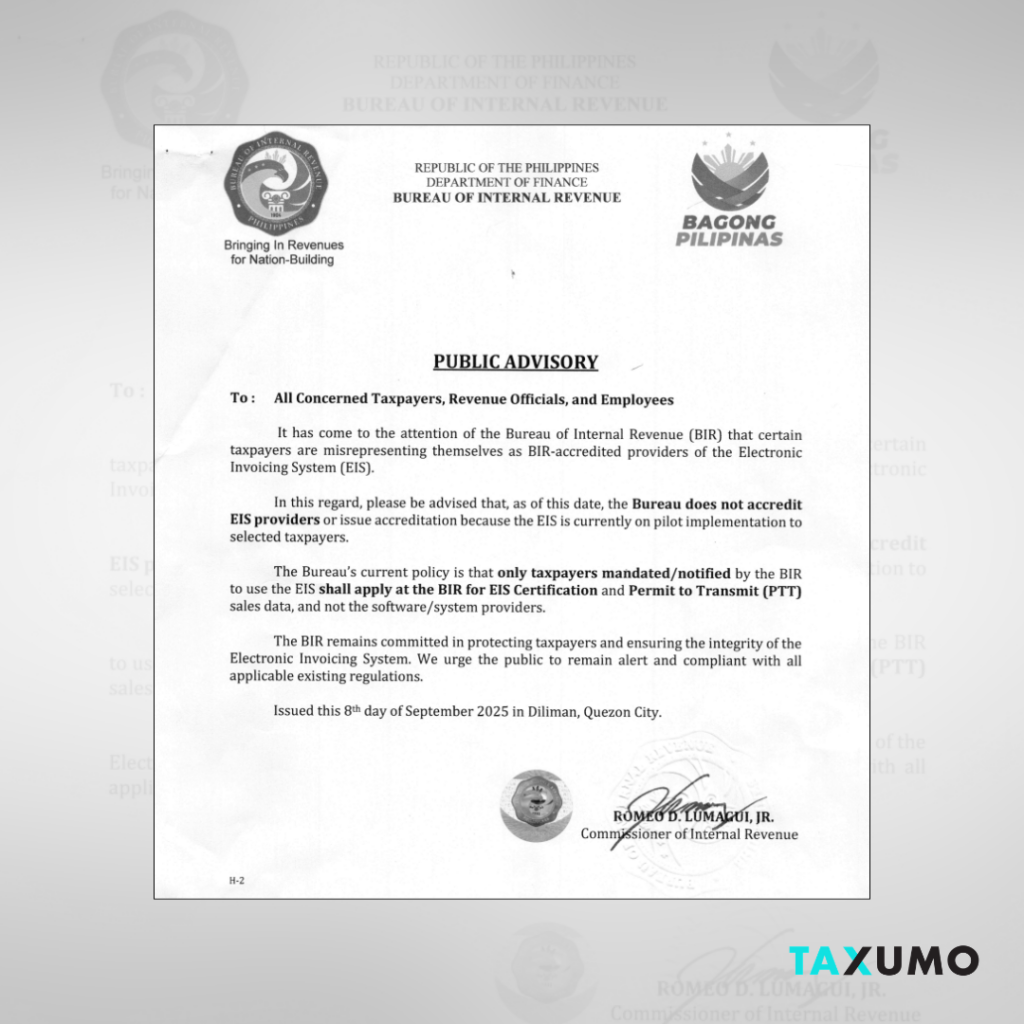
Here’s the part worth watching: as of today, the BIR does not accredit EIS software providers at all.
The system is still in its pilot phase, so there is no accreditation process and no official list of accredited EIS providers yet. Be cautious if a provider claims to be “BIR-accredited for EIS” because the BIR does not offer that accreditation.
Providers can accurately describe their software as EIS-ready, meaning they designed it to meet the BIR’s technical requirements. Accredited and EIS-ready are not the same thing.
In a structured data format. The invoice data must be in a format the BIR’s system can read automatically
You must be able to transmit it to the BIR. The data from the invoice must be able to go directly to the BIR’s EIS, either automatically or within three calendar days of the transaction.
What does NOT count as an EIS ready BIR format invoice:
- A photo of a paper receipt
- A scanned copy of a paper invoice
- A printout from your existing software, especially if that software can’t also transmit the data to the BIR
That last one is the one businesses miss most. You might already be using accounting software that prints nice-looking invoices — but if that software isn’t BIR-accredited and can’t send the data to EIS, those invoices still don’t qualify under the new rules.
Who is covered for EIS?
RR 11-2025 (as updated by RR 26-2025) divides covered businesses into two groups.
Group 1: Comply by December 31, 2026
You fall in this group if your business is any of the following:
An e-commerce or online business — If you sell goods or services online, whether through your own website, a platform, or any internet-based transaction, you are covered. This applies to Small, Medium, and Large taxpayers in this category. Micro businesses are exempt.
Explained further: Your classification depends on your annual gross sales, based on how the BIR groups taxpayers under the Ease of Paying Taxes Act (RA 11976) and RR No. 8-2024. Gross sales here means your total sales revenue net of VAT, counting business income only. It does not include salary from a job or passive income like interest.
- Micro: less than ₱3 million in gross sales. Exempt from the e-invoicing requirement.
- Small: ₱3 million to less than ₱20 million. Covered.
- Medium: ₱20 million to less than ₱1 billion. Covered.
- Large: ₱1 billion and above. Covered.
So if you sell online and your gross sales reach ₱3 million or more in a year, you fall under the e-invoicing rule. If you are below ₱3 million, you are a Micro taxpayer and exempt, though you can still choose to use e-invoicing if you want.
A Large Taxpayer under the Large Taxpayers Service (LTS) — The BIR directly manages certain large businesses through its Large Taxpayers Service. If you’re under LTS, you’re covered.
A Large Taxpayer under the Ease of Paying Taxes Act — The EOPT Act (RA 11976) introduced a classification system for taxpayers based on revenue. If you were classified as Large under this law, you’re covered.
A business using accounting or invoicing software — This includes businesses using a Computerized Accounting System (CAS), Computerized Books of Accounts (CBA) with electronic invoicing, or any other invoicing software. If your business is already using software to manage your books or issue invoices, you’re likely in this group.
If your business has branches, this applies to both your head office and all your branches.
Group 2: The BIR will announce your compliance date in a separate regulation
These businesses will need to comply too, but only once the BIR has built the technical system to receive and store their data. The BIR will issue a separate regulation to announce when these groups must comply:
- Exporters of goods and services
- Businesses with tax incentives under the CREATE MORE Act (Registered Business Enterprises)
- Businesses using Point-of-Sale (POS) systems
- Other businesses the BIR Commissioner may add later
Who is exempt from the EIS (for now)?
Micro businesses are exempt from the mandatory requirement across all categories. You’re not required to issue EIS ready BIR format invoices, though you can choose to do so voluntarily. You can continue using your registered manual invoice, a CAS/Components of CAS, CRM, or POS system instead.
Not sure what classification you are? When in doubt, you can check with our accountant partners for questions
What’s the difference between E-Invoicing and Sales Reporting?
It’s worth knowing that RR 11-2025 actually covers two separate requirements, not just one.
The first is e-invoicing — issuing your invoices in an EIS ready format applied in invoices. That’s what we’ve been discussing, and the December 31, 2026 deadline applies here.
The second is electronic sales reporting — automatically sending your sales data to the BIR through their system. This is a bigger change and applies to the same group of businesses. The BIR won’t enforce this second requirement until it issues a new regulation.
So right now, the main thing businesses need to prepare for is the invoice format itself.
What should the eInvoice system need to do?
Your invoicing software must generate invoices in a structured format the BIR can read — typically JSON or XML. These formats should be registered with the BIR.
Is there a perk for complying with EIS?
You can deduct the cost of setting up a compliant electronic invoicing and sales reporting system from your taxable income, whether you install it voluntarily or because regulations require it.
- Micro and Small businesses: 100% of what you spent on the setup
- Medium and Large businesses: 50% of what you spent on the setup
This is on top of your regular business expense deduction. You can only claim it once, in the year you finish setting up the system or make your final payment for it. Even if you imported the system, the importation is also exempt from taxes.
So if you’re going to need to comply eventually anyway, there’s a financial reason to do it sooner rather than later.
What happens if I don’t comply with EIS?
The BIR cites Sections 264 and 264-A of the Tax Code for violations. Under 264-A, if you fail to transmit your sales data as required, you face fines that accumulate daily. If the violations continue for more than 180 days within a taxable year, the BIR can suspend or permanently close your business.
The bottom line is…
If you run an e-commerce business, use accounting software, or are a Large Taxpayer, December 31, 2026 is the deadline to start issuing EIS ready BIR format invoices. The first step is checking whether the software you’re currently using can actually produce an EIS ready BIR format invoice — meaning it’s BIR-EIS ready and can transmit structured invoice data to the BIR later on.
If it can’t, you can consider adding a BIR-EIS ready tool to your setup before the deadline. The good news is there’s still time to prepare, and the BIR has built in a tax deduction to help cover the cost of transitioning.
This article is based on Revenue Regulations No. 11-2025 (February 27, 2025) and Revenue Regulations No. 26-2025 (September 5, 2025). It is for general information only. For advice specific to your business, please consult a CPA or tax professional.
Please tell me more about EIS. And do you have EIS software already?
Hi Tenorio,
Our invoices are EIS ready only. To check on the qualification, kindly check on the quiz to see which category you fit it 🙂
Pingback: Philippine E-Invoicing for Foreign Companies: 2026 Deadline